5 Effective Bodyweight Exercises for Your Home Workout Routine
Bodyweight exercises offer a practical approach to strength training that does not depend on gym equipment or dedicated spaces. They rely entirely on an individual’s own weight to create resistance, making them accessible for those with limited time or resources. At FitPulse, we often explore movement patterns that can be integrated into daily routines without requiring a significant time commitment. This article discusses five foundational exercises—push-ups, squats, lunges, planks, and burpees—and explains how they contribute to overall conditioning when performed consistently.
Each of these movements targets multiple muscle groups and can be adapted to different fitness levels. The focus here is on understanding their mechanics, variations, and how they fit into a balanced home workout structure. Rather than promising specific outcomes, the following sections describe the methods and considerations involved in practicing these exercises safely and effectively over time.
Regular physical activity that includes bodyweight movements may support muscular endurance, joint mobility, and coordination. However, results depend on many factors, including individual consistency, recovery, and overall lifestyle habits. The information below is intended to provide a clear overview of these exercises and their potential role in a home fitness routine.
Push-Ups: Upper Body Engagement and Core Control
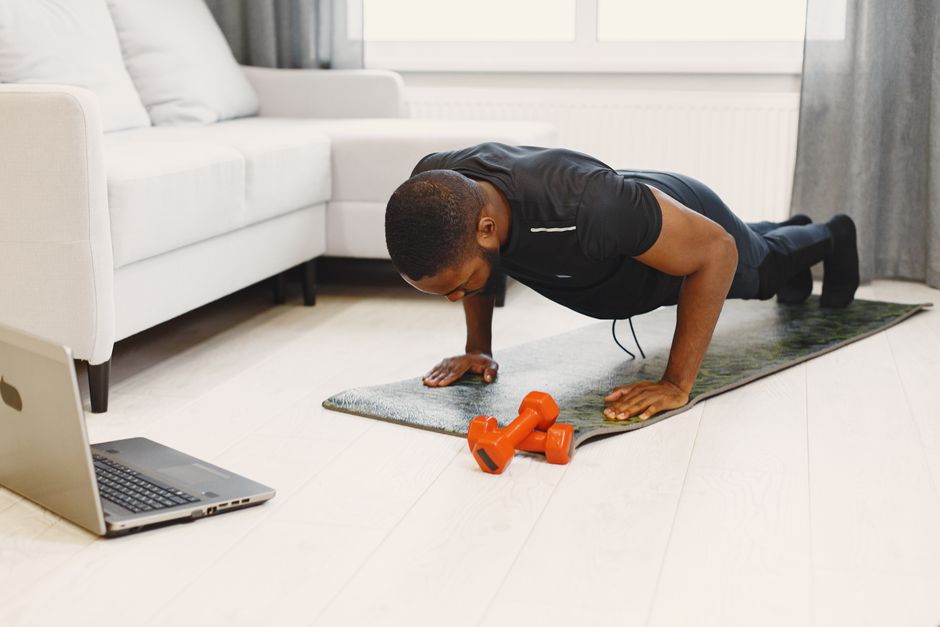
Push-ups are a compound movement that primarily involves the chest, shoulders, and triceps, while also requiring core stability to maintain proper alignment. The standard push-up begins with the hands placed slightly wider than shoulder width, the body in a straight line from head to heels, and the feet together or hip width apart. Lowering the chest toward the floor while keeping the elbows at roughly a 45-degree angle to the torso allows for controlled descent. Pressing back up to the starting position completes one repetition.
Variations exist to adjust difficulty or emphasize different muscle groups. Incline push-ups, performed with the hands on an elevated surface, reduce the load and may be helpful for those developing strength. Decline push-ups, with the feet elevated, increase resistance on the upper chest and shoulders. Narrow hand placement shifts focus toward the triceps, while wide hand placement engages the chest more. Some practitioners also experiment with tempo changes, such as pausing at the bottom of the movement, to increase time under tension.
When including push-ups in a home workout, it is useful to consider the number of repetitions and sets based on current capacity. A typical approach is to perform three to four sets, with rest intervals of 60 to 90 seconds between sets. Tracking progress through increased repetitions or added variations can provide a clear picture of improvement over time.
Squats: Lower Body Strength and Mobility
Squats are a fundamental lower body exercise that targets the quadriceps, hamstrings, glutes, and calves, while also engaging the core for balance. The bodyweight squat starts with the feet shoulder width apart and the toes slightly turned out. The movement involves bending the hips and knees simultaneously to lower the torso toward the floor, keeping the chest upright and the weight centered over the midfoot. The depth of the squat depends on individual flexibility and ankle mobility; a common goal is to reach a point where the thighs are parallel to the ground or lower.
Proper form emphasizes maintaining a neutral spine and avoiding excessive forward lean. The heels should remain in contact with the ground throughout the movement. For those who find full depth challenging, partial squats or using a chair for guidance can serve as a starting point. Over time, increasing depth gradually while maintaining control can help improve range of motion.
Variations such as sumo squats (wider stance with toes pointed outward) target the inner thighs and glutes more directly. Pulse squats, where the individual moves only a few inches up and down at the bottom of the squat, increase time under tension without changing the setup. Jump squats introduce a plyometric element, though they place greater stress on the joints and should be approached with caution. A balanced home routine might include squats performed in sets of 10 to 20 repetitions, depending on the individual’s current conditioning and goals.
Lunges: Unilateral Movement and Balance
Lunges are a unilateral exercise that requires coordination and stability while working the quadriceps, hamstrings, glutes, and calves. The basic forward lunge begins by standing with feet together, then taking a step forward with one leg and lowering the hips until both knees are bent at approximately a 90-degree angle. The front knee should align over the ankle, and the back knee should hover just above the ground. Pushing through the front heel returns to the starting position. Alternating legs completes a set.
This movement challenges balance because each leg works independently, which can help identify and address strength asymmetries. Variations include reverse lunges, where the stepping motion goes backward, placing less strain on the knees for some individuals. Lateral lunges, stepping to the side, target the inner and outer thighs and improve hip mobility. Walking lunges, performed by alternating legs while moving forward, add a dynamic component that increases the demand on coordination.
Lunges require careful attention to knee alignment to reduce unnecessary stress. The knee should not extend beyond the toes, and the torso should remain upright. Incorporating lunges into a workout routine typically involves two to three sets of eight to twelve repetitions per leg. Those who wish to increase difficulty can hold a light object or increase the range of motion gradually, though the core benefit remains the unilateral nature of the movement.
Planks: Core Stability and Postural Support
Planks are an isometric exercise that primarily targets the core muscles, including the rectus abdominis, transverse abdominis, obliques, and lower back. The standard plank starts in a prone position with the forearms on the ground, elbows directly under the shoulders, and the body forming a straight line from the head to the heels. The feet are together or hip width apart, and the abdominal muscles remain engaged throughout the hold. Breathing should be steady and controlled.
The primary focus of the plank is on maintaining alignment rather than duration. A slight upward tilt of the pelvis can help prevent excessive arching in the lower back. The neck should be in a neutral position, with the gaze toward the floor. Beginners might hold the position for 20 to 30 seconds, while more experienced individuals may hold for 60 seconds or longer. However, the quality of the hold matters more than the total time; once form degrades, it is advisable to rest and reset.
Variations such as side planks, where the body is turned to one side and supported on one forearm, emphasize the obliques and shoulder stabilizers. Plank with leg lifts adds a dynamic movement that challenges balance and involves the glutes. Plank to downward dog provides a transition between positions that can be integrated into a flow. Including planks in a home routine often involves performing two to three holds with adequate rest between them, allowing the core muscles to recover while maintaining engagement during each effort.
Burpees: Full-Body Coordination and Cardiorespiratory Response
Burpees combine a squat, a plank, a push-up, and a jump into a single fluid movement, making them a high-intensity full-body exercise. The standard burpee begins in a standing position, then the individual squats down and places the hands on the floor in front of the feet. From there, they jump or step the feet back into a plank position, perform a push-up (optional), then jump or step the feet forward to return to the squat, and finally jump upward with arms extended overhead. Each phase transitions into the next without pausing.
Because burpees involve multiple components, they demand coordination and a certain level of baseline fitness. The exercise elevates heart rate quickly, which can contribute to cardiorespiratory conditioning when performed in sets. However, the intensity also means that form can deteriorate if fatigued, so resting between repetitions is important. Modifications exist to reduce impact or difficulty: stepping back instead of jumping, omitting the push-up, or eliminating the jump at the top. Conversely, adding a full push-up or a tuck jump increases the challenge.
When incorporating burpees into a home workout, it is common to perform them in timed intervals, such as 30 seconds of work followed by 30 seconds of rest, or in sets of 8 to 15 repetitions. The total number depends on the individual’s current conditioning and how the burpees fit into the overall session. Monitoring heart rate and perceived exertion can help guide pacing. As with any movement that involves multiple planes, proper warm-up and attention to wrist and ankle mobility may reduce the risk of discomfort.
These five bodyweight exercises—push-ups, squats, lunges, planks, and burpees—each offer distinct benefits while complementing one another in a balanced home workout routine. The methods described here emphasize gradual progression, controlled form, and personal adaptation. Those who practice them consistently may observe improvements in muscular endurance, coordination, and overall physical capacity, though individual results will vary based on many factors beyond the exercises themselves. FitPulse encourages exploring these movements with patience and attention to one’s own body signals.